
July 14, 2026
Greyboard Thickness 101: Choosing the Right Paper Spec for Board Book Printing
Introduction
If you've ever held a board book and felt that satisfying heft, you've experienced the work of greyboard. This dense, recycled fiberboard is the structural backbone of every board book—the material that gives those chunky pages their durability and resistance to the enthusiastic handling of young readers.
Unlike regular paper, which is measured in GSM (grams per square meter), greyboard is typically specified by thickness in millimeters. A difference of just 0.5 mm can dramatically change how a book feels, how durable it is, and how well it holds up to repeated use. Choose too thin, and the pages warp or feel flimsy. Choose too thick, and the book becomes unnecessarily bulky, heavy, and expensive to produce.
This guide breaks down everything you need to know about greyboard thickness for board book printing—from understanding the numbers to choosing the right spec for your specific project.
What Is Greyboard?
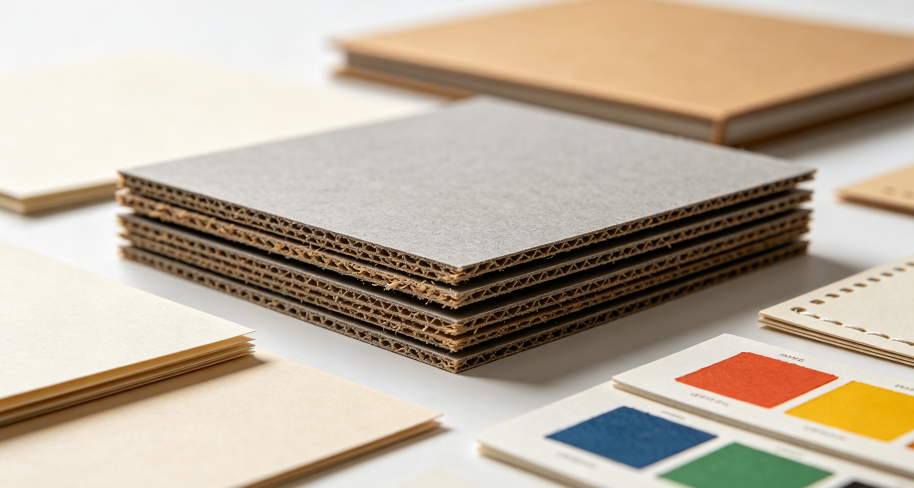
Greyboard (also called gray board, chipboard, or bookboard) is a dense, rigid board made from layers of compressed recycled fiber. It is typically a uniform gray color throughout, with a smooth surface on both sides. For board books, the greyboard forms the core of each page, with printed art paper laminated on both sides to create the final finished page.
Key characteristics:
Made from recycled materials
Dense and rigid—holds its shape under pressure
Resists warping
Available in thicknesses from 0.5 mm to 4.5 mm or more
Provides the structural integrity that makes board books durable
Greyboard is not printed on directly. Instead, printed paper (typically 157 gsm C2S art paper) is laminated onto both sides of the greyboard core to create the final page.
Thickness vs. GSM: Understanding the Numbers
In the paper industry, GSM (grams per square meter) measures weight, while thickness measures physical dimension. For greyboard, these two measurements are related but not perfectly equivalent because density can vary between manufacturers.
Here's a practical conversion reference for greyboard:
Thickness | Approximate GSM | Notes |
0.5 mm | ~300 gsm | Thin, flexible board |
1.0 mm | ~600 gsm | Lightweight board for small components |
1.5 mm | ~900–960 gsm | Standard for many board books |
2.0 mm | ~1,200 gsm | Premium construction standard |
2.5 mm | ~1,500 gsm | Heavy-duty applications |
3.0 mm | ~1,800 gsm | Maximum rigidity |
Note: These are approximate conversions. Actual GSM can vary by manufacturer and board density.
One important distinction: in the U.S., greyboard thickness is sometimes specified in points (pt) , where 1 pt = 0.001 inches. A 60 pt board equals approximately 1.5 mm.
Greyboard Thickness Options for Board Books
Greyboard is available in a wide range of thicknesses, from 0.5 mm up to 4.5 mm or more. Here's how the different thicknesses apply to board book production:
1.0 mm – Lightweight / Small Format
Best for: Very small board books, novelty formats, or lightweight components
1.0 mm greyboard offers basic rigidity but is on the thinner end of what's typically used for board books. It's more common for game tiles or thin rigid components than for full board books.
1.5 mm – Standard Board Book
Best for: Most standard board books, baby's first books, bath books
1.5 mm is the industry standard for board book greyboard. It provides a good balance of durability, weight, and cost. Most standard board books on the market use this thickness.
Typical applications:
Standard 6"×6" or 7"×7" board books
Baby's first books and novelty formats
Projects where cost and weight are primary considerations
2.0 mm – Premium Construction
Best for: Premium board books, books intended for heavy use, art books, and creative projects
2.0 mm greyboard is the premium construction standard. It offers significantly more durability and a noticeably more substantial feel than 1.5 mm board.
Typical applications:
Premium children's board books
Art books and creative projects that emulate the board book feel
Books intended for heavy use and rough handling
Projects where perceived quality is a key differentiator
2.5 mm – Heavy-Duty
Best for: Large-format books, books requiring maximum durability, oversized editions
2.5 mm greyboard provides exceptional rigidity and is used for books that need to withstand significant wear or for larger formats where thinner board might warp.
Typical applications:
Large-format board books (9"×9" or larger)
Books requiring maximum durability
Educational board books with interactive formats
3.0 mm – Maximum Rigidity
Best for: Extra-large format books, coffee-table editions, books requiring maximum structural integrity
3.0 mm greyboard is reserved for the most demanding applications. It provides maximum rigidity and warp resistance but adds significant weight and cost.
Typical applications:
Extra-large format board books
Oversized editions
Books where structural integrity is critical
2.0–3.0 mm – Board Book Covers
Best for: Board book covers
While page thickness typically ranges from 1.0 mm to 1.5 mm, covers are often made from thicker board—2.0 mm to 3.0 mm—to reinforce the book's structure.
How to Choose the Right Thickness
Choosing the right greyboard thickness for your board book depends on several factors:
1. Book Size
Larger books require thicker board to prevent warping. For a standard 7"×7" board book, 1.5 mm is usually sufficient. For a 10"×10" book, consider 2.0 mm or thicker.
2. Target Age Group
Books for younger children (0–2 years) often benefit from thicker board because these books receive the roughest handling. Books for older toddlers (2–3 years) may use standard 1.5 mm board.
3. Expected Use
Will the book be used frequently in a library or classroom setting? Will it travel in diaper bags and endure daily wear? Heavier use calls for thicker board.
4. Perceived Quality
Thicker board conveys a premium feel. If your book is positioned as a luxury or gift product, 2.0 mm or thicker can help justify a higher price point.
5. Weight and Shipping Costs
Thicker board means heavier books, which increases shipping costs. For large print runs, even a small thickness increase can add significant freight expense.
6. Budget
Thicker board costs more per page. The difference between 1.5 mm and 2.0 mm may be small per book, but across thousands of copies, it adds up.
Quick Reference: Thickness by Application
Application | Recommended Thickness |
Standard board book (small format) | 1.5 mm |
Standard board book (medium format) | 1.5 mm–2.0 mm |
Premium board book | 2.0 mm |
Large-format board book | 2.0 mm–2.5 mm |
Extra-large/coffee-table edition | 2.5 mm–3.0 mm |
Board book covers | 2.0 mm–3.0 mm |
The Page Construction: What Goes Around the Greyboard
A board book page is essentially a laminated sandwich:
Greyboard core – The structural foundation (your thickness choice)
Printed art paper – Typically 157 gsm C2S (Coated 2 Sides) art paper, laminated on both sides of the greyboard
Protective lamination – Aqueous or UV gloss coating applied over the printed paper for durability and easy cleaning
The total page thickness is the greyboard thickness plus the thickness of the paper and lamination on both sides. A 1.5 mm greyboard core typically results in a finished page of approximately 2.0–3.0 mm.
Common Pitfalls to Avoid
1. Choosing board that's too thin. Thin board warps easily, especially in humid conditions. A book that feels flimsy won't inspire confidence in parents or retailers.
2. Choosing board that's too thick. Extra thickness adds weight and cost without proportional benefit. For most standard board books, 1.5 mm to 2.0 mm is the sweet spot.
3. Ignoring climate considerations. Board books can warp in humid environments. Thicker board and proper lamination help prevent this.
4. Forgetting the spine calculation. Spine width depends on total page thickness. Even a small change in greyboard thickness affects the spine measurement and cover fit.
5. Assuming all greyboard is the same. Density varies between manufacturers. A 1.5 mm board from one supplier may feel different from a 1.5 mm board from another. Always request samples.
FAQ
Q: What thickness of greyboard is standard for most board books?
A: 1.5 mm is the standard thickness for most board books. Premium construction typically uses 2.0 mm or thicker.
Q: How does greyboard thickness affect the final page thickness?
A: The final page includes the greyboard core plus printed paper and lamination on both sides. A 1.5 mm greyboard core typically results in a finished page of approximately 2.0–3.0 mm.
Q: What's the difference between 1.5 mm and 2.0 mm greyboard?
A: 2.0 mm board is approximately 33% thicker than 1.5 mm. It provides significantly more rigidity, better warp resistance, and a more premium feel. It also adds weight and cost.
Q: Can I use recycled greyboard for board books?
A: Yes. Greyboard is typically made from recycled fibers. However, recycled board should be tested for lead content if the book is intended for the U.S. market (CPSIA compliance requires <100 ppm total lead in substrate).
Q: How do I calculate spine width for a board book?
A: Spine width depends on the total thickness of all pages combined. For board books, this is the thickness of each finished page multiplied by the number of pages. Always provide your printer with the exact greyboard thickness and page count so they can calculate the precise spine width.
Q: What thickness should I choose for a large-format board book?
A: For books larger than 8.5"×11", consider 2.5 mm or 3.0 mm to prevent warping. For a 10"×10" book, 2.0 mm is a reasonable starting point, though 2.5 mm may be safer for maximum rigidity.
Final Thoughts
Greyboard thickness is one of the most important decisions you'll make when printing a board book. It affects durability, perceived quality, weight, cost, and even how the book feels in a child's hands.
The good news is that the range of options—from 1.0 mm to 3.0 mm and beyond—gives you the flexibility to match the board thickness to your specific project needs. Standard books work well with 1.5 mm. Premium books benefit from 2.0 mm. Large-format or heavy-use books may need 2.5 mm or 3.0 mm.
The key is to be intentional about your choice. Don't default to the thinnest option just to save cost, and don't automatically choose the thickest thinking it's always better. Match the thickness to the book's size, target audience, expected use, and market positioning.
And always, always request samples from your printer before committing to a full run. Feel the board. Test its rigidity. See how it handles. Because in the end, the right greyboard thickness isn't just a spec—it's what makes your board book feel like a board book.