
October 15, 2026
Event Photo Book Printing – High-Quality Image Reproduction for Art Exhibitions
1. Introduction
Art exhibitions and event photo books serve a distinct purpose. They are not mass-market publications or casual keepsakes. They are curated objects designed to preserve and present photographic work in a physical format that complements the exhibition itself.
In a fully digital age, a memory turned into a tangible photographic product adds real value to the whole production . The photobook becomes a remarkable keepsake, ready to gift or sell . For artists, galleries, and cultural institutions, the book serves as an extension of the exhibition—a takeaway that allows visitors to engage with the work beyond the gallery walls.
The technical requirements for event photo books differ from standard consumer photo books. Image reproduction must be museum-quality. Papers must be archival. Binding must withstand repeated handling. And the final object must communicate the same artistic intent as the exhibition itself.
This guide examines the technical specifications and production decisions that determine quality in event photo book printing.
2. The Technical Foundation – Resolution and Color Management
The quality of image reproduction begins long before the book reaches the press. Resolution and color management are the two pillars of professional photo book production.
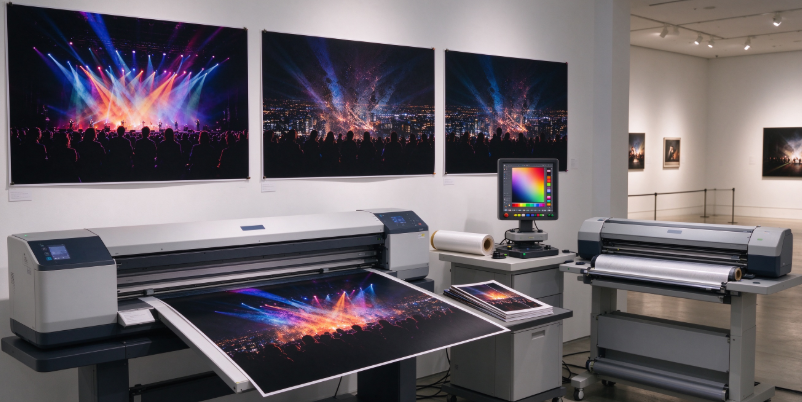
Resolution requirements. The industry standard for fine art photography books is 300 DPI (dots per inch) at final print size, in CMYK color mode . At typical reading distance—roughly an arm's length—300 DPI is the threshold where the human eye can no longer distinguish individual dots . For standard print products viewed up close, 300 DPI delivers sharp, detailed output .
Files submitted at 72 DPI (screen resolution) will print visibly soft . The rule is simple: never scale a low-resolution image up to meet the spec—resample only downward.
Color management: CMYK vs. RGB. Your camera and screen work in RGB. Commercial printers work in CMYK. The conversion is where photographers lose control—saturated blues and deep blacks are the most vulnerable colors in the shift . For gallery-quality reproduction, files should be converted to CMYK before submission . Some printers offer GMG color proofing on every print run to ensure accuracy .
Proofing stages. For critical exhibition books, multiple proofing stages are advisable. A hard proof (plotter/ozalid) provides a low-resolution physical mock-up for layout verification. A wet proof (contract proof) involves printing a few pages on the actual production machine and paper—the only way to guarantee exact color matching before the full run . For offset printing, hard proof color and final book color are approximately 95% the same, and offset samples can be requested to verify final colors before the full print run .
3. Paper Selection – The Canvas for Your Images
Paper choice directly affects image quality, durability, and the tactile experience of the book.
Coated vs. uncoated. Coated gloss or silk paper at 100 lb text weight is the floor for photography books; uncoated paper absorbs ink and softens edge definition, killing the micro-detail that separates a professional print from a consumer photo book . Coated surfaces allow for vivid, high-fidelity printing that faithfully renders color, tone, and detail .
Paper weight options. For luxury photography books, 157gsm to 200gsm represents the "sweet spot" . This range is thick enough to support heavy ink coverage without warping or bleeding through to the reverse side, while providing a stiffness that signals quality . Options include 128gsm to 200gsm for art paper, with heavier 170–200gsm preferred for premium books .
Gloss vs. matte vs. silk. Gloss art paper keeps ink on the surface, resulting in the sharpest details and most vibrant colors—ideal for high-contrast photography and landscapes . However, high reflectivity can cause glare under direct light. Matte art paper offers a sophisticated, non-reflective surface excellent for portraits and black-and-white photography . Silk or satin finishes provide the most popular middle ground, offering excellent color reproduction without harsh glare .
Fine art inkjet options. For limited editions or artist-produced books, Hahnemühle offers linen album cover sets with FineArt inkjet paper options, including Photo Rag® Book & Album (220gsm), Photo Rag® Duo (276gsm), and Photo Rag® Pearl (320gsm) with pearl finish, all available in A4 landscape, A3 landscape, and 12"x12" square formats .
4. Binding Methods – Durability and Presentation
The binding method determines both the book's durability and how the pages present when open.
Smyth sewn binding is mandatory for any coffee table book . Unlike perfect binding (glue only), sewn binding allows the book to lay completely flat when open—essential for panoramic photos that span across a two-page spread, ensuring no detail is lost in the gutter .
Case binding (hardcover) is the prestige option, typically adding 40–60% to per-unit cost on short runs . For exhibition-quality books, hardcover case binding with 2mm or 3mm greyboard adds significant heft and durability . Premium cloth cover materials are available in a wide range of colors and textures .
Perfect binding is the practical choice for runs under 100 copies: it produces a clean spine that can be labeled, holds up well, and costs significantly less . However, perfect binding does not lay flat, making it unsuitable for books with critical crossover images.
Softcover options include Smyth-sewn softcover for stronger durability than standard perfect binding, ideal for portfolios and art photography books . Paperback covers use heavier gloss or matte cover paper (200–350gsm), usually finished with lamination for protection .
5. Finishing Options That Elevate Perceived Value
Specialty finishes distinguish a premium exhibition book from a standard publication.
Cover laminates. Soft-touch matte laminate is the premium choice for fine-art and portrait photographers because it photographs well for social media and feels tactile in hand . It adds roughly $0.80–$1.50 per unit on a short run but changes how the book is perceived the moment someone picks it up . Gloss laminate is vivid and resists scuffs; matte gives a gallery-print feel .
Foil stamping applies metallic gold, silver, or colored foil to the title or logo . Gold, silver, rose gold, holographic, and other colors are available .
Spot UV applies a high-gloss clear varnish only to specific areas, creating contrast on a matte cover . It works well for highlighting specific images or design elements.
Embossing and debossing create tactile raised relief or recessed impressions on the cover material—often linen or cloth . These techniques add texture and sophistication.
Gilded or painted edges apply thin metallic foil or solid color/gradient patterns to the trimmed edges of the book's pages, available in gold, silver, rose, red, and other colors .
Dust jackets add an extra layer of protection and marketing space .
6. Production Considerations – Run Size, Proofing, and Cost
Production decisions involve trade-offs between cost, quality, and quantity.
Run size considerations. Digital short-run printing in 2026 makes 25–50 copy runs practical for event books . Offset printing entails significant setup costs, so typical MOQ for custom luxury books is 500 to 1,000 units . Some printers specialize in shorter runs: QinPrinting offers hardcover and Smyth-sewn photography books from 100 copies .
Cost per unit. A typical 60-page, 8.5×11 coffee table book on 100 lb silk with a perfect-bound soft cover runs roughly $18–$35 per unit at 50 copies . Hardcover case binding at the same quantity is closer to $45–$70 per unit . At 100 copies, hardcover 80-page books start around $11.27 per unit, dropping significantly at higher quantities .
Proofing costs. A single proof copy typically costs $30–$60, regardless of the printer . For offset runs, requesting wet proofs or offset samples adds cost but provides the only way to verify exact color matching before the full run .
Production timelines. A typical timeline for a luxury coffee table book includes file review and proofing (1–2 weeks), mass production (2–4 weeks depending on complexity), and shipping (4–6 weeks for international sea freight) . Short-run digital projects can have lead times of 5–15 working days after file confirmation .
Setup | Binding | Paper | Run Size | Est. Cost/Unit (50 copies) | Best For |
Workhorse | Perfect Bound | 100 lb Silk | 25–150 | $20–$35 | Portfolio, client gifts |
Premium | Case Bound | 100 lb Gloss | 50–250 | $45–$70 | Exhibition, wedding albums |
Proof Run | Perfect Bound | 80 lb Gloss | 1–25 | $25–$45 (proof) | Layout verification |
7. The Exhibition Context – Why Physical Books Matter
The event photo book is more than a product—it's a medium that extends the exhibition's reach and impact.
Archival value. Photobooks have become the medium of choice for many photographers, who develop projects specifically with the book format in mind . Printed objects are physical and sustainable alternatives to digital formats, capable of standing the test of time .
Tangible experience. A photobook offers a rich visual and tactile experience at a very affordable price compared to an original photographic print . The weight of the page as it turns, the way light interacts with the ink, and the durability of the binding all contribute to the perceived value .
Limited editions. Festivals, cultural spaces, and artists use limited-edition photobooks as collectible objects that can be gifted or sold . Single-copy editions or limited collector's runs preserve the exclusivity of the exhibition experience .
The gallery context. For exhibitions, printed objects are becoming a physical alternative to digital formats, offering a rich visual and tactile experience . The photobook festival circuit—events like Photobooks Switzerland and Photo Book Fair—celebrates the printed medium and the ways in which artists communicate through print .
8. Conclusion
Event photo book printing for art exhibitions is a specialized practice that demands technical precision and careful material selection. Resolution must be 300 DPI in CMYK. Paper should be coated, 157gsm to 200gsm. Binding should allow the book to lay flat—Smyth sewn for hardcover, or case binding for the premium exhibition feel. Finishing options like soft-touch laminate, foil stamping, and spot UV elevate the book from a product to an object.
The production decisions—run size, proofing, and cost—must align with the exhibition's goals and budget. Short-run digital printing makes small quantities viable. Offset printing delivers superior quality at scale.
In a digital age, the physical photobook remains the most powerful format for preserving and presenting photographic work. It is an object with weight and intent—a tangible extension of the exhibition itself.
9. Frequently Asked Questions (FAQ)
Q: What DPI do I need for an exhibition photo book?
A: 300 DPI at final print size, in CMYK color mode . 72 DPI (screen resolution) will print visibly soft . Never scale a low-resolution image up to meet the spec—resample only downward.
Q: What is the best paper weight for a photography book?
A: 157gsm to 200gsm is the "sweet spot" for luxury photography books . This range is thick enough to support heavy ink coverage without warping or bleeding through. For offset printing, 100 lb text weight coated stock is the minimum .
Q: What is the difference between gloss, matte, and silk paper?
A: Gloss keeps ink on the surface for sharp details and vibrant colors but can cause glare. Matte offers a non-reflective surface, excellent for portraits and black-and-white work, though colors appear slightly flatter. Silk or satin is the most popular middle ground with good color reproduction and no harsh glare .
Q: What is Smyth sewn binding and why does it matter?
A: Smyth sewn binding allows the book to lay completely flat when open—essential for panoramic photos that span across a two-page spread, ensuring no detail is lost in the gutter . It is mandatory for any coffee table or exhibition-quality photography book.
Q: How many copies should I print for an exhibition book?
A: It depends on your budget and sales expectations. Digital short-run printing in 2026 makes 25–50 copy runs practical . Offset printing typically requires 500–1,000 copies minimum . Some printers offer hardcover photography books from 100 copies .
Q: What is the typical cost per unit for a photography book?
A: A 60-page, 8.5×11 perfect-bound softcover book on 100 lb silk runs $20–$35 per unit at 50 copies. Hardcover case binding at the same quantity is $45–$70 per unit . At 100 copies, hardcover 80-page books start around $11.27 per unit, dropping significantly at higher quantities